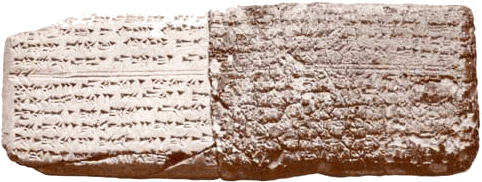
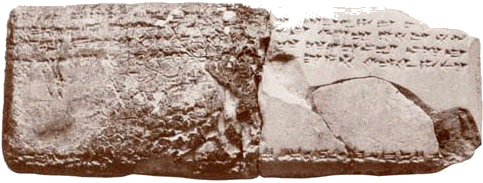
In 1972, after 15 years of research Prof. Anne Kilmer (professor of Assyriology, University of California, and a curator at the Lowie Museum of Anthropology at Berkeley) transcribed one of the oldest known pieces of music notation in the world.
Clay tablets relating to music, containing the cuneiform signs of the "Hurrian" language, had been excavated in the early 1950s at the Syrian city of ancient Ugarit in what is now modern Ras Shamra. One text contained a complete hymn, both words and music and is the oldest known preserved music notation in the world.
Prof. Kilmer transcribed this piece of music into modern music notation. Other individuals have also attempted to transcribe this music, with differing interpretations.
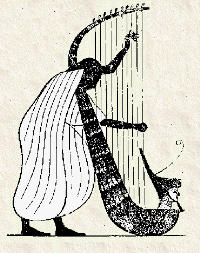
The tablets date back to approximately 1400 B.C. and contain a hymn to the moon god's wife, Nikal. Remarkably, the tablets also contain detailed performance instructions for a singer accompanied by a harpist as well as instructions on how to tune the harp. From this evidence, Prof. Kilmer and other musicologists have created realizations of the
hymn .
MIDI arrangement of Prof. Kilmer's transcription
(NOTE: This and the following MIDI files were recorded as Standard MIDI files, and while the sound of MIDI files will vary according to the sound card and software in your system, it will at least give you an idea of some interpretations of this music. Also MIDI files can opened in many music notation software programs for those you you who might want to work with the notation .)
The next MIDI is an arrangement Marcelle Duchesne-Guillemin's transcription and arrangement of the Hurrian song. See Duchesne-Guillemin's "A Hurrian Musical Score from Ugarit: The Discovery of Mesopotamian Music," Sources from the Ancient Near East 2/2 (Malibu, CA: Undena publications, 1984). There was also an accompanying
cassette recording of male voices singing the Hurrian words (Brandeis
call no. DS 59 H8 D88 1984).
The next MIDI is an arrangement of M. L. West's transcription of the Hurrian song. See his article, "The Babylonian Musical Notation and the Hurrian Melodic Texts," Music and Letters 75 [1993-94] 161-179.

Cuneiform notation from the original tablets
|


New...
The Cider Press Unique PDF ebook collection for historical researchers, music history researchers and for the just plain curious folks out there....
A CD and large, 23-page illustrated booklet titled: "Sounds of Silence: Recent Discoveries in Ancient Near Eastern Music." Anne D. Kilmer, Richard L. Crocker and Robert R. Brown, (copyright 1976), is available from BellaRomaMusic.com, or by emailing jcsmith8@pacbell.net.


Explore - The Amaranth Publishing web pages  including the music of the spheres, the music of a Renaissance alchemist, music created by software and artificial intelligence, the music of the fairies, the music of the Illuminati, the world's most mysterious book, the world's oldest song, a way you can compose music like Mozart, the world's oldest love song, including the music of the spheres, the music of a Renaissance alchemist, music created by software and artificial intelligence, the music of the fairies, the music of the Illuminati, the world's most mysterious book, the world's oldest song, a way you can compose music like Mozart, the world's oldest love song, and much more........ |
|---|