
And Other Early American Composers

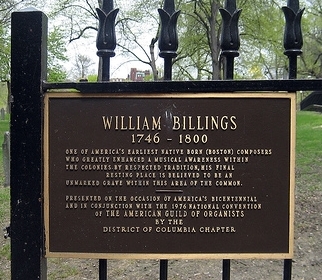
William
Billings (1746-1800), is considered by many to
be the foremost representative of early American music.
Billings was born in Boston on October 7, 1746. Largely
self-trained in music, he was a tanner by trade and a friend
of such figures of the American Revolution as Samuel Adams
and Paul Revere. Billings's New England Psalm-Singer (1770),
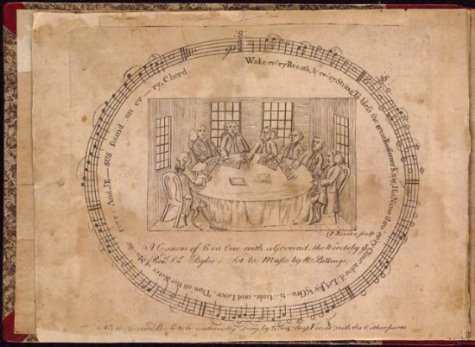
engraved by Revere, was the first collection of music entirely
by an American. (The image above is the frontispiece
engraving for New England Psalm-Singer by Paul Revere)
Especially known
among his compositions are his canon (round) "When Jesus
Wept," the anthem "David's Lamentation," and the hymn "Chester," written
to his own patriotic text and unofficially the national hymn
of the American Revolution. Billings died in Boston on September
26, 1800.
(Excerpts
from an article on William Billings by John H. Lienhard,
University of Houston)
Anyone who's
done much choral singing has sung William Billings's music.
Ask what music came out of Colonial America: we get Billings
and little more. Few sophisticated musicians think much
of him -- I love his stuff. Historians have made little
effort to know Billings. The New Grove Dictionary of Music
and Musicians runs to almost 20,000 pages and it gives
Billings only a page and a half.
Billings was
born in Boston in 1747. He was poor and uneducated -- he
supported himself much of the time as a tanner. But he
also took up music when he was young and was teaching choral
singing by the age of 22.
Biographers
call him a gargoyle. He was blind in one eye with a short
leg and a withered arm. But that's only the beginning.
He practiced what a contemporary called "an uncommon negligence
of person," and he was hopelessly addicted to tobacco --
constantly inhaling handfuls of snuff. That may explain
why he only lived to the age of 54. He had a stentorian,
tobacco-damaged bass voice and he seemed uninterested in
any easy beauty of sound.
At 24, Billings
published his first book of choral pieces. He called it
The New-England Psalm-Singer, and Paul Revere engraved
the frontispiece for it. He published five more volumes
and several pieces of sheet music.
The New-England
Psalm-Singer was the first book of American music. It began
a tradition of musical grass-roots choral singing in America
and Billings knew what he'd done. He delayed publication
over a year -- until he could print it on paper made in
the Colonies. No English imports for Billings. The book
included his song Chester, which rivaled Yankee Doodle
as an anthem of revolution:
Let tyrants
Shake their Iron rod
And slav'ry Clank her galling Chains
we fear them not we trust in god
New England's god for ever reigns.
Ben Franklin
had said art would flow to the west -- to the new American
Athens. What he got was Billings's grand idiosyncratic
music -- no cultural continuity with anything. Billings's
music emerged in the classical, rationalist age, with no
trace of classical elegance. It's an artistic declaration
of independence.
To know Billings,
one should do more than just hear him; one should sing
him -- four-square, almost-medieval harmonies, elaborate
fugues, experiments with dissonance that foreshadow Charles
Ives. He plays musical jokes, praises God, and dances into
the erotic wonder of the Song of Solomon. Then he turns
around and leaves us with one of the most exquisite short
canons we've ever heard,
When Jesus
wept, the falling tear
in mercy flowed beyond all bound ..
The essential
genius of America, and of Billings, was recognizing that
full independence of Europe would eventually be gained
only after we'd formed our own cultural roots.
From
the writings of William Billings:
Perhaps it may be expected that I should say something concerning
rules of composition; to those I answer that Nature is the
best dictator, for not all the hard, dry, studied rules that
ever was prescribed, will not enable any person to form an
air.. It must be Nature, Nature who must lay the foundation.
Nature must inspire the thought.. For my own part, as I don't
think myself confined to any rules of composition, laid down
by any that went before me, neither should I think (were
I to pretend to lay down rules) that any one who came after
me were in any ways obligated to adhere to them, any further
than they should think proper; so in fact I think it best
for every composer to be his own carver.
Perhaps some may think that I mean and intend to throw
Art entirely out of the question. I answer, by no means,
for the more art is displayed, the more Nature is decorated.
And in some sorts of composition there is dry study required,
and art very requisite. For instance, in a fuge, where the
parts come in after each other with the same notes, but even
here, art is subservient to genius, for fancy goes first
and strikes out the work roughly, and art comes after and
polishes it over.
Suppose a company of forty people, twenty of them should
sing the bass, and the other twenty should be divided according
to the discretion of the company into the upper parts. Six
or seven voices should sing the ground bass, which sung together
with the upper parts, is most majestic, and so exceeding
grand as to cause the floor to tremble, as I myself have
often experienced .. Much caution should also be used in
singing a solo (sic); in my opinion 2 or 3 at most are enough
to sing it well. It should be sung as an echo, in order to
keep the hearers in agreeable suspense till all the parts
join together in a full chorus, as sweet and strong as possible.
Excerpt
from an article published in The New England magazine. / (Volume
17, Issue 5, January 1895) by Francis H. Jenks
"It was about 1770 that the Billings craze began. William
Billings was a remarkable man in many re-spects; and the
peculiar fever of which he was the cause was largely due
to his strong personality. He stands in our musical history
as he first self-taught native composer. A collection published
at Philadelphia in 1761, entitled Urania, had furnished him
with models for composition, and working from these he prepared
a host of fugueing tunes, which through their very freshness,
quickly commanded attention. Church music had acquired a
dolefullness due to the slow pace that had become the fashion.
Billings commanded liveliness, and his fugues favored greater
animation than had seemed proper for the plain harmonies
and steady rythmns of the older tunes. The head of the new
school, a tanner by trade, was somewhat deformed with legs
of different lengths, a slightly withered arm and a blind
eye. He had a voice of tremendous power and a manner that
brooked no opposition. There was no one to criticise his
tunes or to controvert his theories, some of which were really
shrewd and sound; and so long as he lived, which was until
the century had nearly expired, he had hosts of followers."
Excerpt
from an article published in The Atlantic monthly - Our
Dark Age in Music - Volume 50, Issue 302, December
1882
"It was about this time (1774) that that eccentric genius, William Billings (born
in Boston, October 7, 1747, died September 26, 1800), taught a singing-school
in Stoughton, with forty-eight members, the best school then known.
That genuine old New England institution, the singing-school,
began about 1720. It was the chief form of social intercourse
shall we say society? In all the country villages; and in
it psalmody, and gossip, and flirtation, we may well conceive,
were learned together, or practiced without learning. Billings
invented a new way of setting hymns and anthems, which was
called the fuguing style. It became extremely popular because
of its vivacity, the voice parts moving in a sort of mutual
imitation (not fugue properly), in quick time, chasing one
another round. O Mather! 0 Judge Sewall! The grave old heavy
psalmody was startled and danced out of its sobriety. Here
was a music that was found exciting; a lively rhythmical
protest (for men had been drinking of the new wine of liberty)
against the dry and dreary old music; a music flattering
to the sense and a relief to the imprisoned spirit.
Whether it appealed to any deep religious sentiment or
not, it set the singers in good humor, and responsive to
the exhortation that we make a joyful noise. Billings was
exceedingly prolific in this kind of composition, and had
imitators, some of whom out-heroded Herod in their ventures
on the sea of bold originality and native inspiration. His
music had a flavor of its own, and showed a certain rude
native talent and invention. Fugue it was not in any right
artistic sense; of all that he was ignorant. What a god-send
it would have been to him, what would he not have thought,
what possibly have done, had there, by any chance, fallen
into his hands some fugues or other compositions, some harmonized
chorals even, of Sebastian Bach or Handel! See how he rhapsodized,
in one of his spread-eagle prefaces, about his new music:
It has more than twenty times the power of the old slow tunes;
each part straining for mastery and victory, the audience
entertained and delighted, their minds surprisingly agitated
and extremely fluctuated; sometimes declaring for one part
and sometimes another. Now the solemn bass demands their
attention, next the manly tenor; now the lofty counter, now
the volatile treble. Now here, now there, now here again.
Oh, ecstatic! Rush on, ye sons of harmony!
Indeed, it seems to have been a sort of musical horse-race.
But there was this gain at all events: music was at last
listened to as music, and not alone as ritual; it was thought
worth the while in itself; there was a chance that it might
come to something really musical in course of time. It was
essentially a secular reaction against plain, solemn psalmody;
but all within the house of worship, the choristers, drunk
with the new wine, setting themselves up on their own account
to do their part in the public service; no strait jacket
any longer, but a general sunburst, and a breaking loose
of the imprisoned school-boys."
Excerpt
from Songs and Ballads of the Revolution. [The New England
magazine. / Volume 19, Issue 4, Dec 1895] Written by
Lydia Bolles Newcomb
About the middle of the last century there was born a man
who may be called the father of church music in America,
the promoter of choirs and singing-schools, and destined
to become famous in his line, William Billings, a tanner
of Boston, odd in appearance, eccentric in speech and manner,
independent in thought and action, but with a soul filled
with music. He calls himself a musical enthusiast, and says: I have
often heard of a poetical license; I dont see why with the same propriety
there may not be a musical license. He spurned the rules of art,
such as there were, and sung out of the abundance of his heart, using,
it is said, the boards of his tannery and the sides of leather, upon
which he chalked the melodies as they floated to his ears. He published
five or six books of psalmody and harmony; and some of the tunes
he wrote are still to be found in old collections of church music.
He was a stanch patriot, and wrote the stir- ring semi-martial air,
Chester, which attained great popularity during the war.
Among the stanch friends and admirers of Billings were
Samuel Adams and Dr. Pierce of Brookline. In the church choir
these two men stood side by side with the old tanner, a trio
of voice and patriotic fervor which one can imagine made
the edifice ring with the words and music here given. Billings
had a special fondness for anthems and fugues. Of the latter
he says: "It has more than twenty times the power
of the slow tunes, each straining for mas- tery and victory,
the audience meanwhile entertained and delighted, the minds
surpassingly agitated and extremely fluctuated, sometimes
declaring for one part, and sometimes for another. Now the
solemn bass demands the attention, next the manly tenor,
now the lofty counter, now the volatile treble now here,
now there, now here again."
|
The Original
American National Anthem
You
would not think that America, after fighting a war of independence
against the English, would choose as its National Anthem,
a Brit tune written for an English drinking
club, right? Well, that's exactly what happened,
even though we had our own American Revolutionary War composers!
Read about it on our Original National
Anthem page. And read about how school children and teachers in America have been contacting their elected officials to ask for official recognition of William Billings and perhaps even a "second national anthem" using his work "Chester".
And amazing as it is........
William Billings appears in HBO movie!
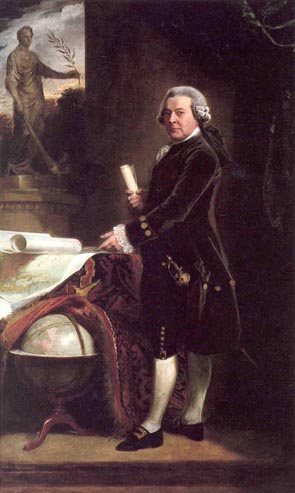
In the recent HBO miniseries about John Adams (pictured at left), in episode 1, there is a scene where the Boston patriots are meeting and at the end of the meeting, they sing a verse of the anthem Chester by William Billings. This may well be the first widespread recognition of the music of William Billings and the fact that Chester was the original National Anthem.
And even better, if you look at the credits of the John Adams series, there is an actor listed as playing the role of William Billings!
If you want, you can download and listen to instrumental MP3s of the anthem Chester, and an excerpt from Billings' Lamentation Over Boston, a piece he composed in reaction to the attack on and burning of Boston by the British. Both of these arrangements are from an upcoming CD of instrumental arrangements of the music of Colonial American composers.
|

Lowell Mason & The "Better
Music" boys -
The Case Of Early American Music Censorship
Just in case you are wondering
exactly why it is that our earliest American composers such
as William Billings remain relatively unknown (even amongst
many musicians, composers and music university graduates)......
go to our Lowell Mason & the "better
music" boys page to find
out. |
Other
Early
American Composers
The
Music & Poetry Of
Francis Hopkinson (1737-1791) Francis
Hopkinson, a signer of the Declaration Of Independence is
best known for his role as an ardent patriot during the American Revolution.
He was also an accomplised poet and composer. We now have a new Web page
for the music and poems of Francis Hopkinson.
|
|
Justin
Morgan
Justin
Morgan (1747-1798) was known both for his elegant
penmanship and as a singing master. He conducted both
writing and singing schools, apparently traveling widely
to do the latter. Morgan was also one of early America's
most original composers.
In addition to
his ongoing musical activites, Morgan was also involved with
horse breeding. The famous "Morgan" horse was named after
him.
Amanda
This unique piece was composed by Morgan for his wife Amanda
who had died soon after the birth of one of their daughters.
Montgomery
Weathersfield
Symphony
Sounding Joy
Huntington
Sovereign Summons

|
|

Timothy Swan
Timothy Swan (1758-1842)
was a native Massachusetts. He began to compose after attending
singing school for three weeks when he was sixteen. After serving
as a fifer during the Revolution, he settled first in Suffield,
Connecticut (about 1783-1807), then in Northfield, Massachusetts,
where he spent the rest of his life. Swan was a hatter by trade,
and also taught singing schools. He was a gifted composer and
something of a poet as well, who wrote and published both secular
and sacred music.
Excerpt from - Fair
Northfield; The Home of the Evangelist Moody - The New England
magazine. / Volume 5, Issue 28, February 1887
"Timothy Swan, the
composer of China, Poland, and other pieces of sacred music,
was born in Northfield, in 1758. The thick hedge of poplars and
lilacs that secluded his house from observation was the home
of a multitude of blackbirds, for which he seemed to have an
special fancy, taking much care to protect them from harm. He
was undoubtedly very eccentric. One of his musical compositions
was written in the presence of a dying child at night. It is
said that the well known China, one of the most lugubrious of
tunes, but a great favorite in old times, was composed while
he was recovering from a fit of intoxication, and was written
with his finger in sand on Beers Plain."
Florence
Rainbow
China
Ocean
Orange
Portland
Calvary
Poland
Greenland
Dover
Golgotha
|
Stephen
Jenks
Between
1799 and 1818 Stephen Jenks (1772-1856) was named as author
or coauthor of ten printed collections of sacred music
and as composer of 125 pieces in these collections. Jenks
was a prolific exponent of the American music idiom developed
by Daniel Read and other Connecticut composers during the
late eighteenth century. Virtually unknown in the cities
of the American seaboard, he flourished in the hinterland
of New England and New York, where he taught singing schools
and cultivated a network of pupils and fellow teachers,
whose compositions he published. In 1829 he moved to northern
Ohio, where he farmed and made musical instruments.
|
|
Jeremiah
Ingalls (1764 - 1828) moved to Newbury, Vermont,
in 1787, and in 1791 began leading the singing at the First
Church there. According to the information we have, the choir
for this church became somewhat locally famous for the time,
and people would travel from miles around to hear them. As
some historians tell it, Ingalls became a Deacon, but was
later removed and after a disagreement with the church leaders,
was excommunicated in 1810. Ingalls had operated a tavern
in the Newbury area for a number of years, but supposedly
sold it and moved to Rochester, Vermont, after the conflict
with the church.
Some of the following pieces may not have been composed by Ingalls
but appeared in his interesting music publication "The Christian
Harmony". This New England tunebook of 1805 contains some of the
earliest examples of folk-hymns and spirituals.
|
Daniel Read
Daniel
Read was born in Attleborough, Massachusetts,
16 November, 1757; died in New Haven, Connecticut,
in 1841. He was a manufacturer of combs in New Haven,
but at the same time composed music, and published
in 1791 "The American Singing-Book, or a New and Easy
Guide to the Art of Psalmody," and in 1793 "Columbian
Harmony," a collection of devotional music. Subsequently
he published a "New Collection of Psalm-Tunes," which
came to be known as the "Litchfield Collection," containing
many tunes of his own composition (Dedham, 1805). " Windham," "Greenwich," "Sherburne," "Russia," "Stafford," and
others of Read's hymn-tunes are still in general use
in American churches.
Sherburn
Greenwich
Windham
Winter
Stafford
Mortality
Russia
Amity
Broad Is The Road
Lisbon
Judgement
Salem
|
Abraham
Wood
Abraham
Wood (1752-1804) was a native of the Massachusetts
Bay Colony and a drummer during the Revolutionary
War. He was a prominent composer in early America
and apparently was associated with William Billings.
"Warren," by Abraham Wood is a memorial for the patriot leader Joseph Warren
(1741-1775), an army officer who died courageously at age thirty-four in the
Battle of Bunker Hill.
"A Hymn on
Peace" by Abraham Wood appeared in 1784, the year after the Treaty
of Paris officially ended the Revolutionary War. The poem, unattributed
and of unknown authorship, had been published earlier in Andrew
Law's Collection of Hymns (Cheshire, Conn., 1783), where is was
designated to be sung to Wood's psalm tune "Worchester." "A Hymn
on Peace" circulated in a rather unusual way - not, as was the
most common, as part of a larger collection of sacred pieces,
but as a single pamphlet. The Boston Independent Chronicle, May
6, 1784, advertised it as "just published" and stated it would
be sold by Wood in Northboro, and interestingly - ".. by William
Billings, near Liberty Pole, Boston. " This advertisement reveals
the the only known connection between two of early America's
leading composers.
Worcester
Marlborough
Warren
|
Captain
Supply Belcher
From a Belcher
family geneaology web site:
Supply
Belcher (1751-1836) was born in Stoughton, Massachusetts
and, at one time may have sung in the Stoughton Music
Society (the first choral organization in America) under
composer William Billings.
Records that include a muster roll of the
Minute Men from Stoughton state that a Private Belcher
and Corporal Billings marched on April 19, 1775, upon receiving
the alarm from Lexington about an impending armed
engagement with the British.
Belcher would eventually rise to the rank
of Captain under General Washington. After the war ended,
he became a tavern keeper. He eventually moved to Maine,
and while living in Farmington, Maine he was employed
in various occupations including but not limited to-
town clerk, selectman, teacher, singer and composer. He
was Farmington's first representative to the legislature
at a time when Maine was still a part of the state
of Massachusetts. Even while accomplishing all of the above,
Belcher managed to compose at least sixty-eight compositions,
most of which appeared in "The Harmony of Maine", 1794,
published the same year as Billlings' last collection, "The
Continental Harmony"."
(Note - We found these compositions attributed to Supply Belcher
in an old music publication, but we have not been
able to verify if Belcher actually wrote these
works. We have often found pieces of music erroneously
attributed to various early American composers in
19th Century American music publications so we try
to verify and double-check. Whatever the case may
be, the pieces of music are interesting.)
Harmony
Conversion
Invitation
|
Lewis
Edson
The
early American composer, Lewis Edson (1748-1820),
wrote three
of the most popular tunes of his time - Bridgewater, Lenox and
Green Field. In 1763 Edson began working as a blacksmith, but by
1769 he was also a singing master and eventually became quite well
known as a singer. Edson married in 1770 and in 1776 the family
moved to the Berkshires in New York, perhaps because they were
Tories. It was in New York where Edson began composing. His three
well known tunes were published in 1782 in a publication named
the "Choristers Companion". After the American revolution, he taught
singing in Massachusetts, New York, and Connecticut. He moved to
Woodstock, Connecticut, in 1817.
Bridgewater
Green
Field
Lenox
|
Elisha
West
We
don't have much of anything in the way of information
about the life of Vermont composer and arranger of religous
music, Elisha West (1752-ca. 1808. But
we did uncover this odd story on a genealogy web service.
According to the story:
"West and his wife were known to be very fond of heavy drinking, which was considered
at the time to be a quite unusual given the nature of his music work; and even
more unusual when they divorced in 1807 when Elisha was over 50 years of age."
We have no idea of the truth of this story, If you have any information
about the life of Vermont composer Elisha West, please send it
it us.
America
Edom
Sharon
|

Early American Music CD
We are in the process of creating a CD of 2 collections of the choral music of early America. This CD is designed to show examples of the often very beautiful music of early American choirs, composers and cloisters. If you are interested in purchasing a CD, please contact us by
e-mail.
The Utopian Choirs
Of Early America

In Early America, there were various religious and communities often connected to teachings related to Rosicrucianism, the concept of a "New Atlantis", and various what would now be called occult teachings. Some of these communities composed and performed beautiful choral music.
Johannes Kelpius and his followers arrived in newly-founded Philadelphia from Germany in 1694 and chose the wild and beautiful Wissahickon as the best place to await the millennium. The mystics became known as "the Hermits of the Wissahickon," "The Society of the Woman in the Wilderness" or the "Mystic Brotherhood." Kelpius composed and arranged some unique choral music.
The Ephrata Cloister or Ephrata Community was a religious community, established in 1732 by Johann Conrad Beissel at Ephrata, in what is now Lancaster County, Pennsylvania. Beissel taught music at the Cloister and wrote hundreds of songs and choral works. Many of the other members of the cloister also devoted themselves to poetry and music. Their choir became widely known.
MP3 Samples
Sample excerpt of the music of the Ephrata Cloister
Sample excerpt of music composed by Kelpius
Sounding Joy
The Tunesmiths Of Colonial America
Many examples of the music of Early American composers such as William Billings, Timothy Swan, Stephen Jenks, Justin Morgan and more.........
MP3 Samples
Sounding Joy - Justin Morgan
Rainbow - Timothy Swan
Pleasure - Stephen Jenks
When Jesus Wept - William Billings
|
The Power Of Music
A CD of music from the notebooks of early American artist, musican, composer and collector of tunes of all kinds, William Sidney Mount.

Traditional and original music from the notebooks of early American painter, musician, folk music collector and composer,
William Sidney Mount (1808-1868)
Arranged for guitar, fiddle and flute.
MP3 Samples
Miss Betty Forbes Reel - Excerpt
Shep Jones Hornpipe - Excerpt
If you are interested in purchasing a CD, please contact us by
e-mail.
|
Explore the Amaranth Publishing pages....................
Explore - the world's most
mysterious book, music composed by a Renaissance alchemist, the Amaranth Publishing CD collection, the oldest
song in the world, the world's oldest love song, the music of the Illuminati,
unique sheet music, the world's most haunting melodies, the music of the spheres, a way you can become rich if you
can solve a historic cipher, a way you can compose
music just like Mozart, the
19th Century American X-Files and much more....
|
If you
have any questions you can contact us by e-mail, (sometimes
our spam filter overreacts and rejects valid e-mails, so, if you
get an e-mail rejection notice, please try again later), or
if you prefer by telephone at 817.921.3670.
Amaranth
Publishing Home Page
© Copyright 2007
- Amaranth Publishing - All Rights Reserved
|